Monday, May 11, 2015

Rainy Day Fun


Some days fly by in a flurry of fun. We had one of those days today, where the rain kept us inside and made us get creative about setting up a few centers to provoke the children's interest and curiosity.

Our ECE noticed the Year One children showing a great interest in rocks they found in the school yard. On Friday they filled a bucket and enjoyed washing all the rocks. One of their ideas involved painting the rocks and selling them (for forty-one cents). My team partner set up a table with their rocks, paint, and some "rock" labels.  

I took the opportunity to work on the "ock" word family with the Year Two students! 

During our long inquiry block in the morning, I set up a fun chemistry experience after having observed the children creating "potions" in our creative center by cutting up bits of paper and fabric. 

I made the Borax solution ahead of time, and found this experiment really quick and satisfying because of the ease of the steps and the level of involvement I could give the children. 

You can find a run-down of the process here (on my personal blog).

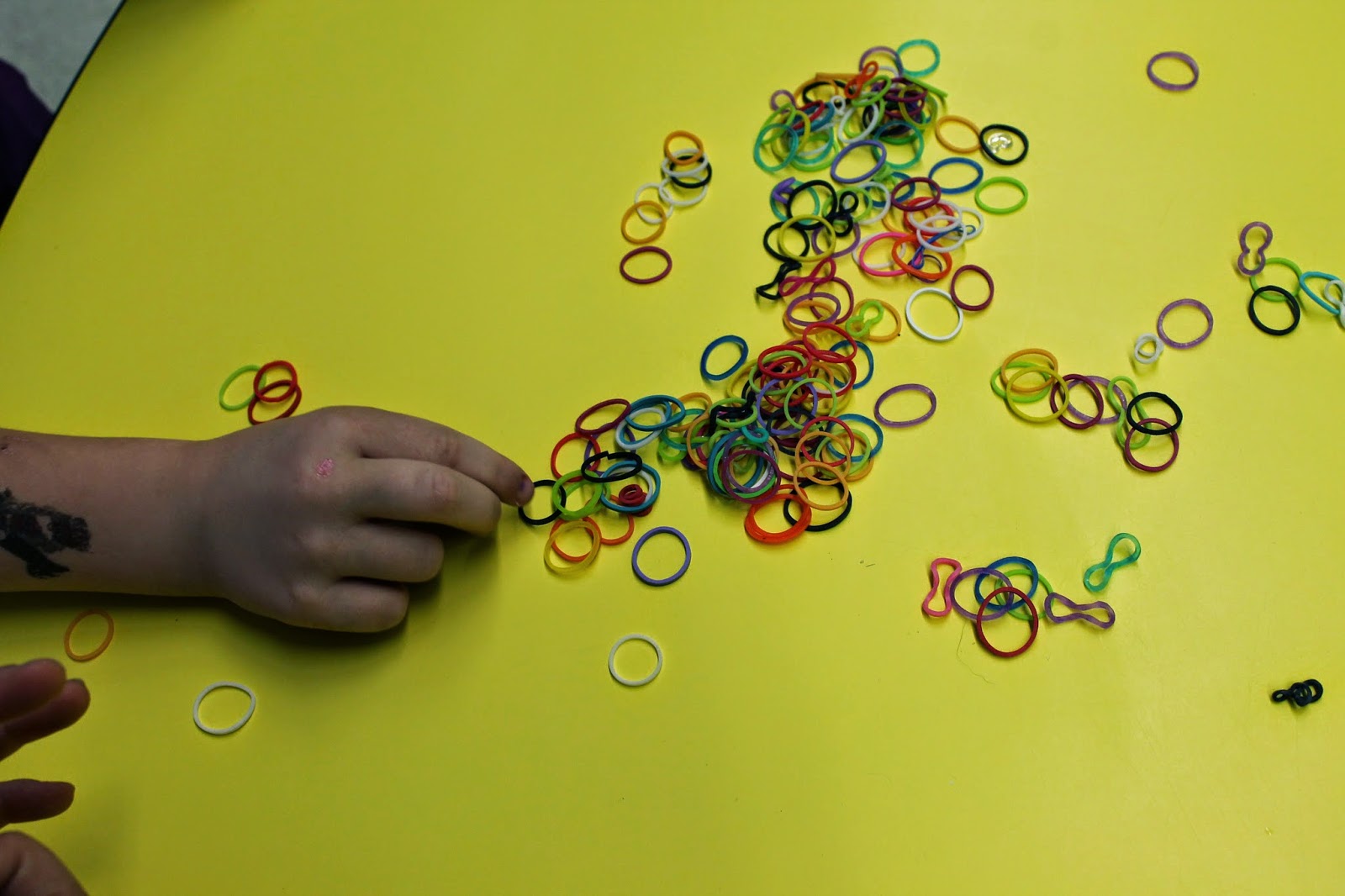
Finally, I pulled out a bag of elastics I had from last year when the children went through a rainbow-loom phase. I'd learned how to create simple bracelets using only our fingers (no looms needed) and it sparked all kinds of wonderful engagement: measurement, patterning, counting, oral communication, procedural writing, and so on.

Basically, you create a figure-8 with an elastic on two fingers of one hand. The second (and all subsequent elastics) go on just in a circle (no twist). Pull the first (bottom) elastic up and over the second one, allowing it to slip in between the fingers. Then repeat by putting on another elastic and pulling the bottom one up and over. Secure with a c-clip to create a bracelet, or make it longer to create a necklace.

It was great to see the Year Twos (who found this too hard last year) teaching the Year Ones how to do this! 

What tricks do you have to get you through those rainy, indoor-recess days?

Tuesday, April 21, 2015

free to take risks


When the weather is fine they choose to spend our gym period outside. We race to the back corner of the school yard where the trees grow wild and there are so many hiding places.


 I've learned to relax about rules, and to deal with making them with the children when the need arises. When a child asks me to boost them up into the tree higher than they can climb on their own, I kindly decline. 

Upon reflection, the children agree that getting up and down safely, confidently, and independently is more important than getting higher up with help (and possibly being afraid or getting hurt).


They express their personal experiences of the outdoors by pretending to camp or hunt. Stories are told around these camp fires, and hearts pound in a game of chase-and-find.

They experiment with the spring of a low branch, and only go as far as they can reach without falling or breaking the branch. This they do without instruction or warning. By taking risks, they learn to assess the ways they might damage themselves or their environment. Their confidence and coordination grows, and they file away this experience for future use.

Sometimes they want to just gather and chat in small groups.

Sometimes they find a place to hang out all alone.

One little hand explores the marks left behind by tiny creatures and wonder at the paths she finds there.

A huge boulder just outside the boundaries of the school yard, combined with a part of the fence where they can squeeze through invites them (with permission) to scale its side and pose for some artsy photos. I wish all children could experience the sheer freedom of a play space without boundaries!

Suddenly, a hand-full of leaves tossed into the air is plastered to the fence by the wind. "The fence is magnetic!" The cry goes up and several run to join in covering as much of the fence with leaves as possible before the wind dies down. They marvel at how they can defy gravity with the help of the wind!
Another rule arises when the girls decide to create a shelter. Long limbs pivot and fall heavily, and one ill-timed swivel results in one of the boys being "clotheslined" at full speed. We discuss the use of long branches and decide that it might be safer to limit ourselves to only using branches that are the same height as the children.

They work hard and play hard, and I'm always reluctant to tell them that it's time to return to the four walls of our classroom. They are growing right before my eyes, in their strength, coordination, endurance, confidence, and ability to set safe boundaries for themselves. 


Tuesday, April 14, 2015

Shadows: An Inquiry Begins


This morning during our play and inquiry time, many of the children chose to play outside. I noticed one girl up on the hill, dancing slowly and concentrating carefully. It soon became clear that she was watching the movements of her shadow, so long and clear in the bright morning sun. I quickly shot a brief video of her, along with a boy who had joined her to squirt water from a bottle. His shadowed wiggled and shifted with his enjoyment of his play, but did not draw his attention.

As soon as the children returned to the classroom I shared the video on our screen. I asked them what they thought M was doing. "dancing", "karate kicks", "ballet", and "wiggling" were some of their responses. I asked them to watch the video again, this time noticing what was happening around the girl and boy.

Right away someone called out, "Shadows!", so we watched the video one more time with the shadows as a focus. The children noticed how the shadow was long, dark, and imitated the movements of the students.

We generated a list of their thoughts and ideas about shadows:
  • Shadows are bigger than we are
  • Sometimes they go away when the clouds come
  • The clouds block the sun and it has to be half clouds and half sun. 
  • My shadow does whatever I'm doing. It's like a video outside but it's not on a screen.
  • The sun is very bright and the back of you reflects the sun.
  • It makes the same shape as you.
  • The sun shines down on your back but not in front of you so that's why your shadow is in front of you.
  • There are all different shapes of shadows.
  • When you're driving, the car has a shadow too. When I stuck my hand out of the car I saw its shadow!
  • The sun shines on your belly and the shadow is on your back.
We explored our knowledge of shadows by using the bright sunlight that pours into our classroom! Someone just donated a box of dinosaurs to our class so we used these to create shadows, and traced them. This was challenging because the children had to work around their art without blocking the sunlight!

When they finished, they filled their shapes with black paint. Some chose to cut their shapes out. Later in the day we went outside and two of the children noticed that their shadows were holding hands! We observed that our shadows looked smaller than the one from this morning had. Tomorrow I think we'll trace our shadows through the day to make some conclusions about how they change according to the sun's position in the sky.


Thursday, March 26, 2015

Learning About Mammals


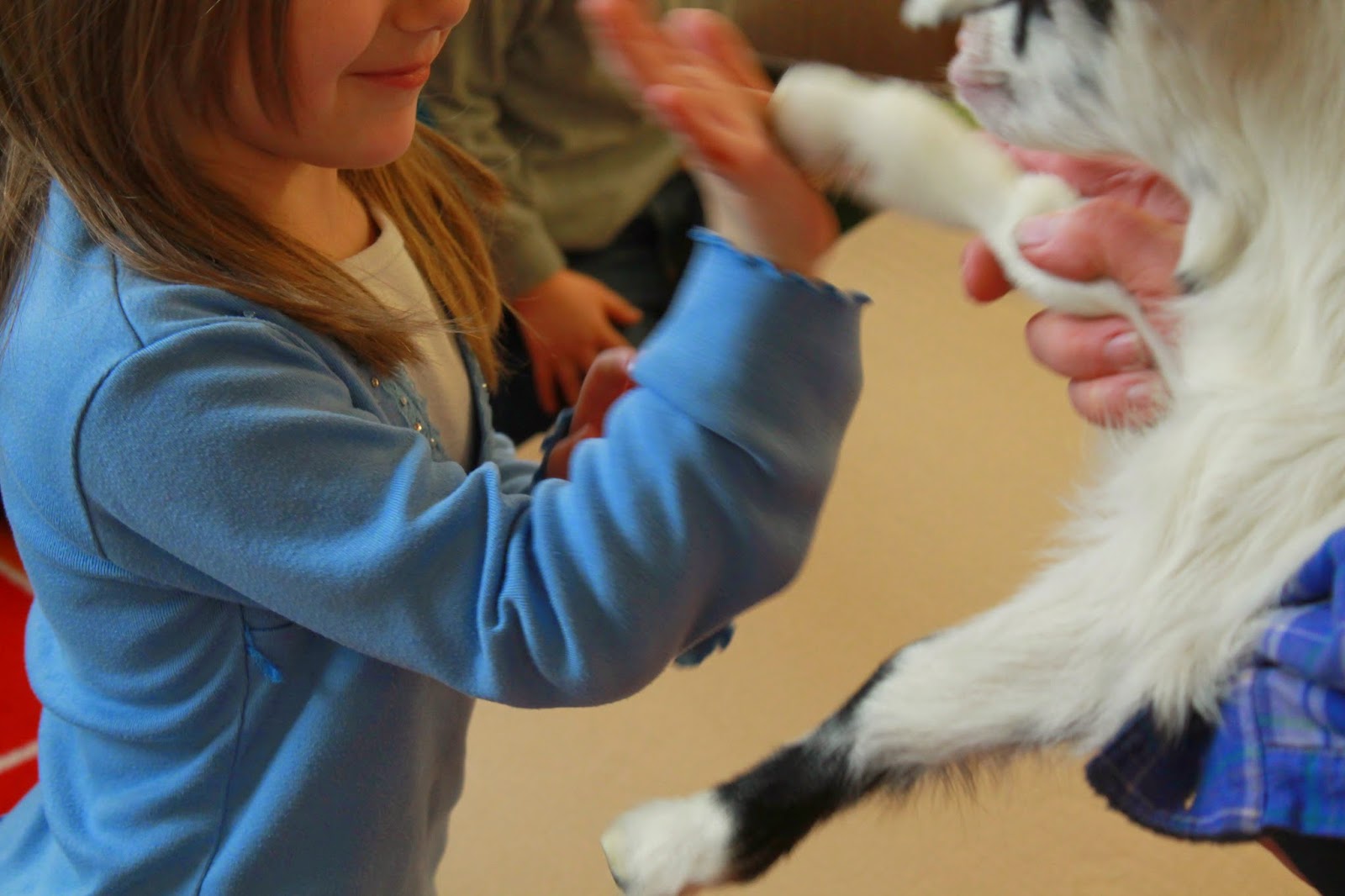
Our ECE gets some Goat Love.

Action shot...I get nibbled on the chin by a loveable goat baby!

Each child got a goat high-five when it was time to say goodbye.

One of the benefits of teaching at a rural school (and of living on a hobby farm) is that there are always so many creatures at hand to be brought in to the classroom. My principal once joked that she was going to have to start patting me down at the door because of my habit of bringing animals into the classroom. Chicks, ducklings, and baby bunnies are just the start of the list.

Children are naturally curious about living things, and I have always felt that modelling the gentle and compassionate treatment of animals while sparking the children's sense of connection with other living things is an essential component of what we teach in Kindergarten.

This morning a goat-farming, soap-making friend was gracious enough to bring her baby goats in for a visit! Before they arrived, we had a discussion about goats as mammals, in comparison with humans. With a few "leading" questions, the children were able to deduce from their previous knowledge that mammals:

  • have fur or hair
  • give birth to live babies
  • are warm-blooded
  • make milk to feed their babies
Many of the children have baby siblings and were able to relate to the notion that baby mammals nurse from their mothers. One of the children said, "Even YOU, Mrs. Pinkerton?" (they know I have a toddler) and they took it in stride that I also make milk to feed my baby! I also mentioned that many farm babies as well as human babies are bottle-fed. 

We discussed the uses of goats: for meat, for milk, and as pets. We talked about what can be made from goat milk. One of the children brought up the fact that there are also wild goats who can climb mountains. 

We were asked to create a "play structure" for the goats as it would encourage them to stay in one place. We had generated a list of ideas last week (one of which was that we should put the goats in buckets and pull them up into the loft using rope). We settled for some large cardboard pallets leaned on our upturned recycling box. 

The children did so well containing their excitement in order to be calm and quiet when the goats were with us! The little fur babies pranced from child to child, wagging their little tails, nibbling on ears and fingers, and trying to climb on everything and everyone. They were certainly adorable! 

When it came time to write in our journals, every child wrote about our visit from the baby goats. 

Tonight we'll be getting our piglets to be raised as meat. I suspect I may be bringing one (or two) of them in for a visit soon! I also have a tame chicken but my principal has asked me to draw the line at bringing our ponies to school. Too bad, isn't it? :)

Wednesday, March 11, 2015

Have You Seen Birds?

Inquiry can be a funny thing. Like a flock of birds, it can start off in one direction but before you know where it might be going, it changes direction. Some of the birds go one way, while others go another way. It can be challenging to keep track of them all, but exciting to witness!

Our students had so many questions and conversations about birds. We always start our inquiries with some little activity or book to spark the children's interest, followed by co-creating an "I think I know" chart. We call it this because it allows the children to "change their thinking" if the knowledge they gather through the inquiry contradicts a preconception they may have had. It also allows us to get an idea of the children's background knowledge and previous experience with the topic we are exploring. 


Once we have an idea of the kinds of questions the children have (by creating an "I wonder" chart), we create a "map" for ourselves of ideas for discussions we might have, resources we can gather, and ways to link their explorations to the Kindergarten Document. This is an exciting task, revealing the vast possibilities presented by following the children's interests. We don't write anything in stone, because as I mentioned, the direction can change quickly (and often in ways that we can't anticipate!). 


A combination of books from our classroom, school, and community libraries ensures that the children have many resources to explore!

The books we gather inform much of our inquiry, and inspire the children to ask deeper questions. Themes of diversity, compassion, healing after loss, caring for the environment, and the connection between humans and animals flow through the rich literature we read aloud to our students, and we're continually amazed at the children's ability to grasp of deep topics.

Activating prior knowledge is a powerful tool before we read a rich text.


Soon, the exploration spills into other centres around the room, particularly the creative centres. Without prompting, the children create play dough birds complete with feathers, eggs in nests, and mama birds to sit on them. As they create, we circulate and discuss their work with them to learn more about their understanding of the topic of inquiry.

"Why do you think the mother sit on the eggs? How long do you think it takes for the eggs to hatch? Do you think the father bird help? Is the baby bird in the egg when the mother bird lays it, or does it grow?"
A key component of inquiry is that we do not GIVE answers to the children, but discuss questions with them and help them find information they need. The end result is not necessarily the RIGHT answer, but a deepening of their ability to ask questions about the world around them.


As the days and weeks pass, the children widen their exploration into dramatic play (by building nests with blocks and flying in search of food), science (by observing the birds that visit our feeders, studying our field guide, and enjoying non-fiction texts and videos), language arts (through read-alouds, poems, and fingerplays), and mathematics (keeping track of bird visitors on a tally chart, graphing types of birds we've seen, and learning about egg sizes). 


The word family list on the right arose spontaneously as the children noticed the rhyming words in this poem. They were very excited to think of lots of "est" words!

We investigated bird behaviour through the seasons when we read this beautifully illustrated fiction text while learning about how a bird-loving boy takes care of the wildlife in his backyard. We also enjoyed reading Riki's Science Journal as we read the story.

With the warm weather, we've observed the return of the Canada Geese, and are starting to hear a greater variety of birdsong! This is an exciting time of year to delve into the feathery world of birds!


Tuesday, February 24, 2015

Helping Out Our Feathered Friends

In the early winter we talked a lot with our students about how animals survive the Canadian winter. We read many fiction and non-fiction texts on the topics of migration and hibernation, created charts of who does what, had a classroom visitor from the Ministry of Natural Resources who shared migration route maps with us (and even had a taxidermied Gray Owl to show us!), and explored hibernation through writing and art.

At this late moment of winter, however, it is time to consider the scarcity of food many animals face as the season continues.

Today we created birdseed ornaments to support our feathered friends through the remainder of the winter! I started with a modelled writing session, showing the children how to write, read, and follow a procedure. 

Then we broke up into smaller groups and got to work (or play, depending on how you see it) to create our ornaments.

Birdseed Ornaments

You will need:
3/4 cup flour
1/2 cup water
3 Tbsp. corn syrup
1 envelope gelatin
4 cups birdseed

To create the ornaments:
1. Mix the flour, water, corn syrup, and gelatin in a medium bowl. 

2. Add the birdseed and mix well till all the seed is coated in the mixture.

3. Firmly press the mixture either into an oiled muffin tin, or into cookie cutter shapes set on an oiled pan.

4. Insert a piece of straw into the ornament to create a hole (for inserting a string for hanging).


5.Allow to dry for 2-3 hours, then carefully remove from tins or cutters and turn over. Allow the other side to dry for 2-3 hours.

6. Insert a string, and hang for the birds to enjoy!

We will hang our ornaments on the big pine tree outside our classroom window. We will leave a clipboard by the window with some binoculars and a bird identification guide so we can keep track of the kinds of birds that visit.

Wednesday, January 21, 2015

January Ramblings

A bear den...lift the lid to see the bear sleeping inside!

Labelling an illustration of an animal that survives the winter outside.

Winter animals celebrate Christmas in the sensory bin filled with Epsom salts.

A beaver!


Tracing, painting, and cutting out numbers.

Creating art based on Ezra Jack Keats' "The Snowy Day".

Co-created number anchor charts in the works.

Sometimes it feels like we're doing everything but just being in the now of teaching Kindergarten. From November's progress reports to Decembers concerts and open-houses, into January's cold-weather warnings and February's report cards, there are so many places for our attention to be. 

This has been a busy year so far! Extreme cold weather has forces many indoor recesses on us which do take their toll after several days in a row. My teaching partner and I were busy preparing a presentation to other Kindergarten educators in our board when I came down with the flu. Close on its heels was bronchitis, which flattened me and kept me from work for a week. Add to that the inevitable illnesses of my toddler, husband, and older children, and you can understand how grateful I am to just BE here today, focused on the children in our class.

Since our return after Christmas holidays, we've been exploring ideas around how animals survive the harsh winter. As a rural school, many of the children have experiences of seeing animals like wild turkeys, deer, porcupines, and birds outside in the snow. Through rich read alouds, we have come up with many questions and answered most of them! The children loved creating charts of animal behaviours in winter (hibernate? migrate? stay here?), and were very diligent about recording all the animals they could think of. Their interest in animals spilled over into the sensory bin, art centre, and creative centre where one little girl in particular loved sculpting Canadian animals that we had discussed during our circle times.

I've been wanting to get the children working on a number wall since early fall, but the interest didn't seem to be there. Today the conditions were perfect somehow, and some of the Year 2s got busy tracing our number lacing shapes. I asked them to paint them then wondered aloud how else we could show the numbers we'd created. Different students contributed their fingers for photographing, or glued pompoms on ten frames.

I'm enjoying just being here in each moment of the day, observing the children, and making plans to extend their learning and understanding. We've had some great discussions about maps and globes and I sense a new inquiry blossoming. 

Stay tuned for a "teacher tutorial" for a beautiful art project we created last week!