Wednesday, February 10, 2016

Learning Letters


On Monday the children are always excited to see Bobble, our classroom "pet". He's a rabbit in a hat, and although he doesn't speak, he always has lots to share by whispering in my ear. He also has a letter in his paws each week to add to the bank of letters the children have learned so far!

Once we've used our "magic pencils" (our fingers) to draw the letter in the air, we watch two videos on YouTube that feature the letter and its sound: the first by ABC Mouse, and the second by Bounce Patrol. 

We work together to co-create a list of words that begin with the letter of the week, and the children like to challenge my drawing skills!

The classroom ECE (Early Childhood Educator) sets up a centre where the children can join her to create letter sound charts. The children search through old books to find pictures of things that start with the letter sound. These are then displayed for easy reference, and are used at the play dough centre where the children can create the letters with play dough "snakes"!

In addition to learning the look and sound of the new letter, I spend time with the children modelling and practising how the letter is formed. For our younger students, this might be their first time printing the letter. For the older students, this extends into "slow as a snail" printing, where I give them a word that features the sound, and they do their best to represent each individual sound (phoneme) with a letter or a combination of letters! The children are very proud to show off their wonderful printing skills and we often see the letter popping up here and their in their play and work.

We reinforce the letter learning throughout the week. The children love to go on "letter hunts" by taking a walk through the school and finding the letter of the week in environmental print (on posters, signs, etc.). They also enjoy finding the letter in texts in the classroom. 

It is amazing how quickly the children learn and retain these individual sounds, and before we know it, they are combining the sounds to print and read simple words!


Monday, February 1, 2016

Art Matters: Exploring Art in Three Dimensions


Art projects in our classroom are always offered as a voluntary choice among our centres. Some children come to explore every single offering, while others need encouragement to try new techniques and projects. I rarely offer a sample of a "finished product" to encourage an open-minded approach to art, and an understanding that there is no "right way" to create. 

I invited the children to explore 3D art in our Creative Centre by providing the children with lots of pieces of cardboard cut in different shapes, bits of cardboard tubes, and larger pieces to act as backdrops. Using wood-glue (because it has a stronger hold than white glue), the children got busy creating 3D art. 

With no example provided of a final product, the focus was on the process of artistic creation. Some of the children chose not to use any circular shapes, and others followed my example (because I always sit and create alongside them) of gluing some pieces vertically. The children's conversations revolved around what their artwork "looked like": "This is a fence", "This is a mountain", "This is the dish for the cat".  We also chatted about how 2D art is different from 3D creations.

Creating art for art's sake is not a new concept for children, but as they get older they become more focused on creating art that looks like something. It was freeing for them to just glue pieces on wherever they wanted without any pressure to have their art represent a concrete scene or image.

When the glue was dry, the children were invited to add colour using craft paint. Once again, the focus was on the children's choices
whether or not to add colour, and what colours to add.

Some of the children have asked to go back and add more details to their work in the form of textures and patterns painted on top of the original colours. We'll get to that this week!

Thursday, June 18, 2015

Class Trip to Red Wolf Retreat


We couldn't have ordered better weather for our class trip last week! The occasional cloud cover discouraged sunburns and the breeze kept the bugs away. In keeping with our mantra of "take learning outside", we visited Red Wolf Retreat with our JK/SK class. With an army of parents to help us keep track of everyone, we boarded the bus with excitement. Many of the children are brought to school by parents or are picked up by small vans, so the experience of getting a ride on the BIG YELLOW BUS was a good start to the day!

Upon our arrival, we visited the herd of goats that live at Red Wolf Retreat. The children were allowed to pet a small kid and marvelled at the size of the billy goat. We learned about predators in the area and how the owners protect the goats.

Next we headed to a small pond where the small trout live, and enjoyed watching Bill (our host) feeding the fish. The water "boiled" with splashing fish as they vied for food. Many of the children got splashed in the face which caused lots of giggling! The children got a close look at a beautiful speckled trout when Bill fished it out of the pond in a net. We learned about what fish need to live, and about how Bill and his family keep them and their environment healthy.

We wandered down a path to the lake where we would catch our own trout. The children took turns using the fishing rods, and it didn't take long for them to get lots of bites! The incredulous looks on their faces was worth the trip as they proudly showed off their catch! Every child got to practise their patience and eventually, everyone caught a fish. They were taken to be cleaned and bagged, so we went to have our lunch.

A basketball net, soccer ball, and old canoe kept everyone entertained while we ate, then it was time to catch some pond creatures. The children were given nets and instructions about not touching frogs or turtles with their bare hands (because of the possibility of salmonella and other bacteria). We spied a nest in some cattails, containing four red-winged blackbird chicks. Mama and Papa Bird were not thrilled at our presence, so we tried to give them adequate space.

As the children scooped their nets through the water they brought their catches back to Bill for identification. He placed them in a shallow tub of water so everyone could observe the many kids of critters that live in pond. They got to see tadpoles in various forms of metamorphosis, and heard the frogs singing. Dragonfly nymphs, caddisfly cases, a water strider, and so many other creatures gathered in the tub as the children excitedly gathered around.

Another tub contained some little minnows. The children were allowed to gently scoop them up in their hands to feel them wiggling. This kind of hands-on experience is so rich for small children.

If you live in the Eganville area, I highly recommend a school trip to Red Wolf Retreat! Respect for living things and the natural world as well as a safety around water were focuses of the day, and everything was very well organized. The children LOVED catching a fish and proudly brought their trout home to share with their families for dinner. Everyone found something to enjoy on our trip and everyone was well tuckered out on the drive home!


Thursday, May 21, 2015

Take Learning Outside


As the weather warms up, we find ourselves gravitating to our outdoor space. There is always a free-style flow from indoors to out, with one adult in each space to supervise, foster learning, and nurture the children's natural curiosity! 
As a teaching team, we alternate weeks outside, and plan engaging invitations to play. A child who is less enthusiastic about choosing the outdoor centre might be enticed outside by a chance to explore some slime, and a child who usually wants to play hockey outside might be drawn in by a fun math game in the classroom.

Sensory and art activities work equally well inside or out. Literacy and numeracy opportunities arise organically when children are provided with enticing materials (seeds, soil, measurement tools, chalk, paint, and so on). 

We're always interested to note that there is a fairly consistent balance in the numbers of children inside and out. Instead of having a "schedule" of who goes in and who goes out, we encourage self-regulation by encouraging the children to make this choice based on how they are feeling each day.  

Whether inside or outside we ensure that there are plenty of choices for all kinds of play (social/emotional, gross motor, fine motor, dramatic). We also support different groupings (solo play, or in pairs, or in small groups), and marvel at the beautiful flow that takes place as the children drift in and out of play groups.
By taking learning outside (reading under the trees, for example), we easily engage our young learners. They are eager to pack their backpack with a snack and some "just right" stories that they can enjoy all by themselves in a shady place of their choosing. Changing the setting gives children (and teachers!) a new perspective, and offers many opportunities for spontaneous learning (and teaching).

Providing a variety of materials supports the growth of the many different learning styles. Art supplies blend as easily into our outdoor space as does sports equipment. There is truly something for everyone, and every learning style is considered valuable and relevant. Loose parts such as log slices, thick branches, and smooth stones offer limitless opportunities for open-ended play.
Being outside nurtures a child's imagination. Today a Year One student found a big branch and declared it a dinosaur bone. His friend found a smaller stick, craggy and twisted, and they worked to piece together their fossil skeleton. This led to a "tall tale" about how the first boy came across the bones, complete with dramatic pauses and shifts in volume. A plain old branch inspired this young child to create a story full of drama on the spot, and he clearly demonstrated his developing adeptness with oral language while sharing his growing awareness of the structure of a story. Each time I watch the video I took of his retell, I notice more and more (e.g. his use of connecting words like "so", "then", and "next").
Through experimentation and exploration, the children learn about their world. One day while we walked in the wooded area of our schoolyard, I came across some berries. I pretended that I was going to pick them and eat them. "Wow, look! Delicious berries! I'm going to eat some because I'm really hungry!" "No, Mrs. Pinkerton!" came the cries of my vigilant charges. "Those are Mother Nature's berries!" Another student corrected, "You shouldn't eat them because they might be poisonous". 
Al fresco learning reduces behavioural issues. Children who need a lot of movement and space get the physical activity they require to help them settle later in the day. Splitting the students into smaller groups reduces crowding in the classroom. We educators enjoy more  rich time with individual children when we are supervising less students, and are able to engage more deeply with learning explorations.
Being outside offers a sensory experience. Today we found Lily of the Valley blooming in our wooded area, and lay right down on our bellies to look closely at their tiny bell shapes. The children thought they looked like fairy hats, or fairy tea cups. My fairy-loving daughters will notice some of their fairy storybooks missing next week when I bring them in for the children to explore!

They were enchanted by the scent and sight of these beautiful little flowers. The apple blossoms that are in bloom perfume the paths we travel, and we listen to the bugs, birds, wind, and frogs that surround us. I suspect that these early experiences with the wonders of the outdoors will influence these children as they grow; I hope they will always seek the outdoors as a place of interest, exercise, and peace.
I've noticed an improvement in the overall physical health of the children in our class, in terms of their stamina, coordination, and endurance. There is also much less whining when one gets a little scrape or scratch! They are learning the limits of their bodies and what kinds of risks are reasonable. They are learning to pick themselves up when they fall down, assess what caused the fall, and try again. In addition to improving their physical health, I notice their emotional development: they are more confident, resilient, and calm when they have plenty of time to explore and play outdoors.
Any learning experience can be brought outside! We've done Circle Time, Math/Numeracy, Literacy, Art, Physical Education, Science, and Snack Time outside. The sky is literally the limit. Take your class outside and see what benefits you can add to this list! 
Please share your thoughts in the comments below!

Monday, May 11, 2015

Rainy Day Fun


Some days fly by in a flurry of fun. We had one of those days today, where the rain kept us inside and made us get creative about setting up a few centers to provoke the children's interest and curiosity.

Our ECE noticed the Year One children showing a great interest in rocks they found in the school yard. On Friday they filled a bucket and enjoyed washing all the rocks. One of their ideas involved painting the rocks and selling them (for forty-one cents). My team partner set up a table with their rocks, paint, and some "rock" labels.  

I took the opportunity to work on the "ock" word family with the Year Two students! 

During our long inquiry block in the morning, I set up a fun chemistry experience after having observed the children creating "potions" in our creative center by cutting up bits of paper and fabric. 

I made the Borax solution ahead of time, and found this experiment really quick and satisfying because of the ease of the steps and the level of involvement I could give the children. 

You can find a run-down of the process here (on my personal blog).

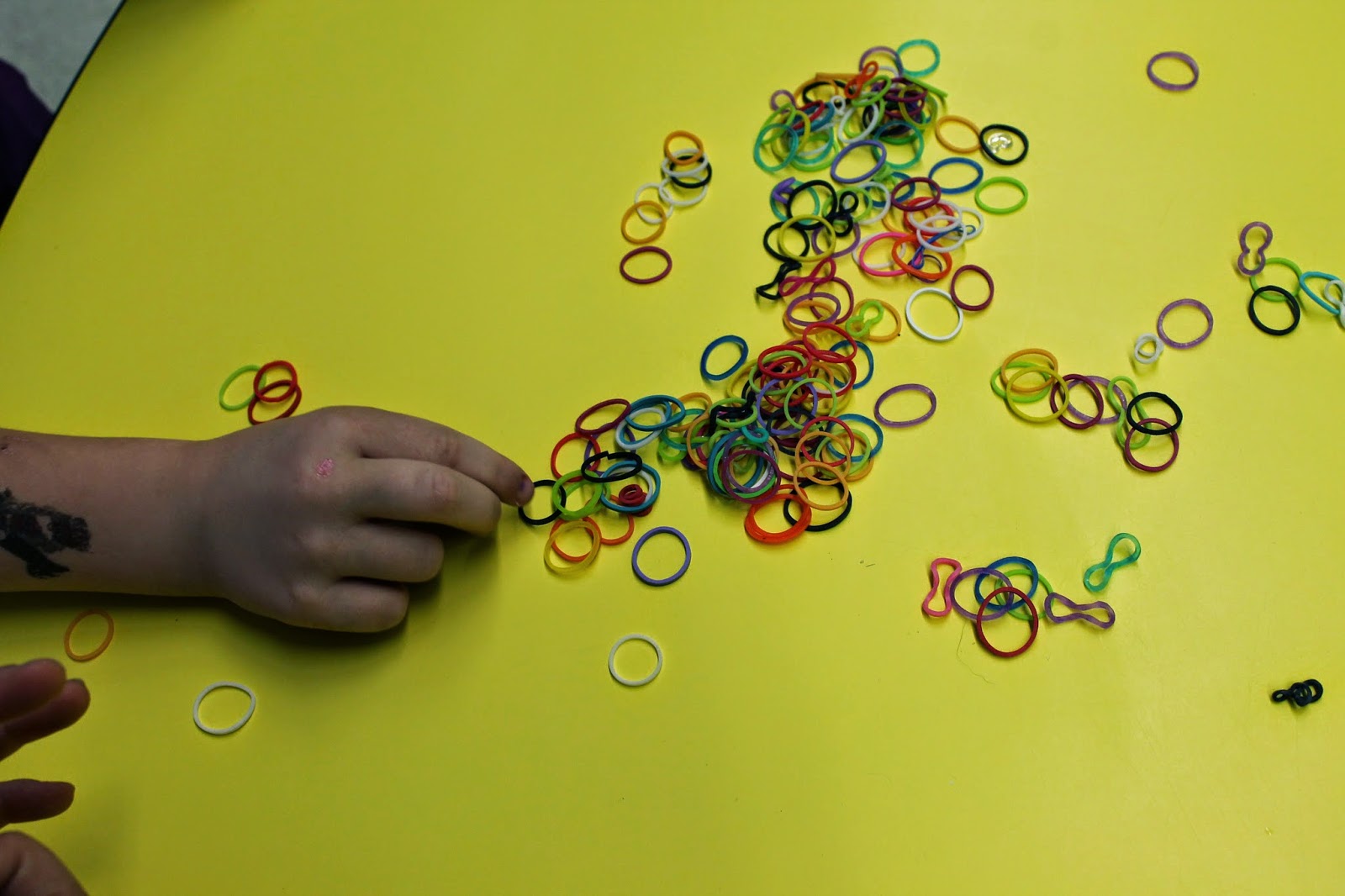
Finally, I pulled out a bag of elastics I had from last year when the children went through a rainbow-loom phase. I'd learned how to create simple bracelets using only our fingers (no looms needed) and it sparked all kinds of wonderful engagement: measurement, patterning, counting, oral communication, procedural writing, and so on.

Basically, you create a figure-8 with an elastic on two fingers of one hand. The second (and all subsequent elastics) go on just in a circle (no twist). Pull the first (bottom) elastic up and over the second one, allowing it to slip in between the fingers. Then repeat by putting on another elastic and pulling the bottom one up and over. Secure with a c-clip to create a bracelet, or make it longer to create a necklace.

It was great to see the Year Twos (who found this too hard last year) teaching the Year Ones how to do this! 

What tricks do you have to get you through those rainy, indoor-recess days?

Tuesday, April 21, 2015

free to take risks


When the weather is fine they choose to spend our gym period outside. We race to the back corner of the school yard where the trees grow wild and there are so many hiding places.


 I've learned to relax about rules, and to deal with making them with the children when the need arises. When a child asks me to boost them up into the tree higher than they can climb on their own, I kindly decline. 

Upon reflection, the children agree that getting up and down safely, confidently, and independently is more important than getting higher up with help (and possibly being afraid or getting hurt).


They express their personal experiences of the outdoors by pretending to camp or hunt. Stories are told around these camp fires, and hearts pound in a game of chase-and-find.

They experiment with the spring of a low branch, and only go as far as they can reach without falling or breaking the branch. This they do without instruction or warning. By taking risks, they learn to assess the ways they might damage themselves or their environment. Their confidence and coordination grows, and they file away this experience for future use.

Sometimes they want to just gather and chat in small groups.

Sometimes they find a place to hang out all alone.

One little hand explores the marks left behind by tiny creatures and wonder at the paths she finds there.

A huge boulder just outside the boundaries of the school yard, combined with a part of the fence where they can squeeze through invites them (with permission) to scale its side and pose for some artsy photos. I wish all children could experience the sheer freedom of a play space without boundaries!

Suddenly, a hand-full of leaves tossed into the air is plastered to the fence by the wind. "The fence is magnetic!" The cry goes up and several run to join in covering as much of the fence with leaves as possible before the wind dies down. They marvel at how they can defy gravity with the help of the wind!
Another rule arises when the girls decide to create a shelter. Long limbs pivot and fall heavily, and one ill-timed swivel results in one of the boys being "clotheslined" at full speed. We discuss the use of long branches and decide that it might be safer to limit ourselves to only using branches that are the same height as the children.

They work hard and play hard, and I'm always reluctant to tell them that it's time to return to the four walls of our classroom. They are growing right before my eyes, in their strength, coordination, endurance, confidence, and ability to set safe boundaries for themselves. 


Tuesday, April 14, 2015

Shadows: An Inquiry Begins


This morning during our play and inquiry time, many of the children chose to play outside. I noticed one girl up on the hill, dancing slowly and concentrating carefully. It soon became clear that she was watching the movements of her shadow, so long and clear in the bright morning sun. I quickly shot a brief video of her, along with a boy who had joined her to squirt water from a bottle. His shadowed wiggled and shifted with his enjoyment of his play, but did not draw his attention.

As soon as the children returned to the classroom I shared the video on our screen. I asked them what they thought M was doing. "dancing", "karate kicks", "ballet", and "wiggling" were some of their responses. I asked them to watch the video again, this time noticing what was happening around the girl and boy.

Right away someone called out, "Shadows!", so we watched the video one more time with the shadows as a focus. The children noticed how the shadow was long, dark, and imitated the movements of the students.

We generated a list of their thoughts and ideas about shadows:
  • Shadows are bigger than we are
  • Sometimes they go away when the clouds come
  • The clouds block the sun and it has to be half clouds and half sun. 
  • My shadow does whatever I'm doing. It's like a video outside but it's not on a screen.
  • The sun is very bright and the back of you reflects the sun.
  • It makes the same shape as you.
  • The sun shines down on your back but not in front of you so that's why your shadow is in front of you.
  • There are all different shapes of shadows.
  • When you're driving, the car has a shadow too. When I stuck my hand out of the car I saw its shadow!
  • The sun shines on your belly and the shadow is on your back.
We explored our knowledge of shadows by using the bright sunlight that pours into our classroom! Someone just donated a box of dinosaurs to our class so we used these to create shadows, and traced them. This was challenging because the children had to work around their art without blocking the sunlight!

When they finished, they filled their shapes with black paint. Some chose to cut their shapes out. Later in the day we went outside and two of the children noticed that their shadows were holding hands! We observed that our shadows looked smaller than the one from this morning had. Tomorrow I think we'll trace our shadows through the day to make some conclusions about how they change according to the sun's position in the sky.